What it's Like Learning with AI Tools

About three years ago I wanted to learn electronics. I was motivated by a project idea where I wanted to go all out in a custom lighting system around my desk. I had a vision in my mind for how it should work, but the electronics aspects of it were complex: multiple zones, dimming, and a lot of higher power lights. Even though the vision was clear in my head, the execution of the electronics part of it was outside of my skillset. I bought Make: Electronics with the requisite supplies to go through the labs. The book is great, but three years later, I'm not much closer to completing the project. Even though I still really want to finish it, I gave up because I was not learning what I needed to learn fast enough. Reflecting on it, part of the reason was that the book was slightly too far removed from my actual goal and going through it all did not make my end goal easy enough. Recently I had another similar experience, but this time related to a home plumbing situation where I was left wishing I had the skillset to fix something myself. There's a pattern emerging here - I love learning new things - it is very empowering to do things how I want them on my timeline. These days it's a $400+ minimum for any trade work, and you can only afford to call in the professionals so often, which motivates me further. But on the flip side, it's hard to pick up new skills when you are working full time on something else.
Long exposition aside, something I have been mulling for a while is whether AI could meaningfully make learning these skills fast and fun enough to make it feasible for me to learn these new skills. I want it to be able to design for me a curriculum that is tailored to what I want to learn, but also still reference the great books and resources that are out there. AI is infinitely patient, can produce different ways of explaining things, come up with infinite practice exercises, etc. that should make it effective at making learning better and faster. In this blog, I wanted to share my experience trying to make a custom curriculum for learning plumbing so that anyone could try to replicate it for whatever they are interested in. In the future, I also want to research what the theoretical learning speedup could be for someone if they had a perfect tutor (which AI is not right now). But in this blog the focus is all practical and more of a tutorial of what I did and the results were both incredibly exciting, but also in other areas left me wishing AI labs focused more on this problem of educating rather than automating professions at a rapid pace.
Getting Started with a Plumbing Curriculum
These are the tools I used which are easily accessible to anyone:
- GitHub Copilot app (I will refer to it as GHCP). Claude Cowork and the Codex app would be comparable.
- I primarily used Opus 4.8 with high reasoning effort
- Obsidian for viewing and editing the documents that GHCP produced.
- I briefly used some image generation tools in Gemini's Nano Banana through the Gemini web app and ChatGPT.
The Master Plumbing Plan
When it comes to learning a skill like plumbing, the most important aspect is building up experience. Licensed plumbers go through years of apprenticeship, while classroom teaching makes up a small fraction. So what gives me hope that I can compress those years into something I can do myself assisted by AI? First, the projects and jobs I want to do are very targeted for a standard home: water, sinks, toilets, showers - pretty much everything is DIY friendly. Some of the jobs are also easy and low risk which provides an on-ramp. I took pictures of everything relevant so that I could use it as part of the AI helping me create a curriculum. This also will let me personalize the learning to the things that I care about. However, an on-ramp of the projects around the house is not enough. On its own it's too little, and would move too fast into higher-risk work. With this in mind, I spent the most time trying to get GHCP to create a series of labs that I could work through which would give me practical experience in a low-risk environment. Still, no amount of labs would match the guidance an apprenticeship would give, so another aspect to help fill that gap for me was to build up a knowledge base. Next, my job and skillset already requires a lot of on the fly problem solving and debugging - if I can learn the principles, I am confident in my diagnostic abilities. Finally, I wanted this organized into a textbook of sorts, in a lot of ways similar to how Make: Electronics is structured with some theory, but mostly labs, videos, and interactive elements. The nice part about this is that the AI is building the custom glue for me - it still references books and other media.
Setting the Stage
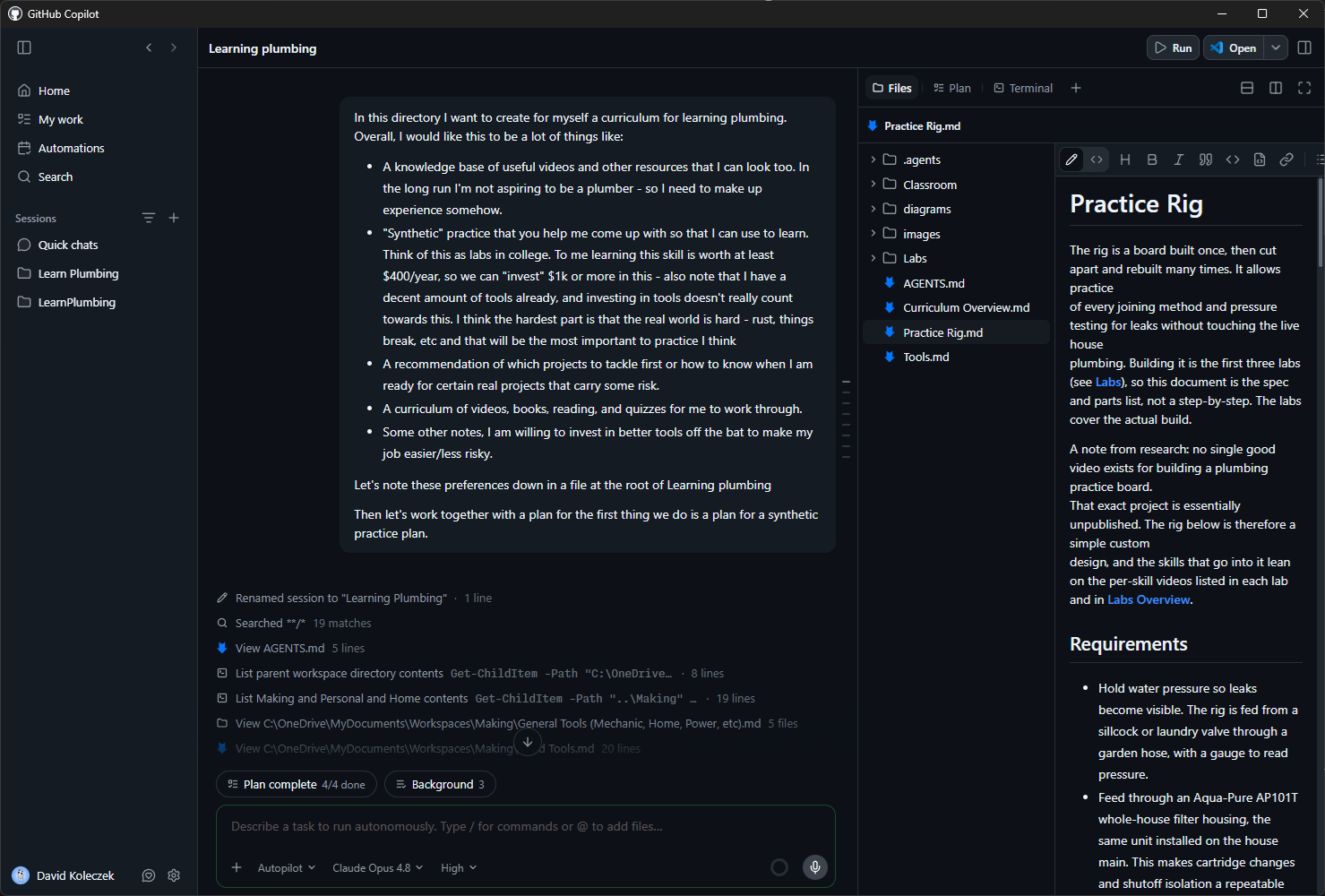
One of the keys I have found when approaching building with AI is to spend some time setting the stage for the tool. By default, it knows nothing about you and each new conversation/session has no idea what the previous one did. For work like this I do three things: keep everything well organized in a directory, keep my overall preferences and goals in a single document that the AI can use to orient itself, and maintain an AGENTS.md. I view the preferences and goals document as like the course syllabus with an index, while the AGENTS.md contains preferences of how I want the agent to behave, like writing style or how often to ask questions. With that in mind, I started a new GHCP chat in a directory called "Learn Plumbing" on my OneDrive and sent it this long message in plan mode, essentially a rough version of all the exposition I have done up to this point.
In this directory I want to create for myself a curriculum for learning plumbing. Overall, I would like this to be a lot of things like:

A knowledge base of useful videos and other resources that I can look too. In the long run I'm not aspiring to be a plumber - so I need to make up experience somehow.
"Synthetic" practice that you help me come up with so that I can use to learn. Think of this as labs in college. To me learning this skill is worth at least $400/year, so we can "invest" $1k or more in this - also note that I have a decent amount of tools already, and investing in tools doesn't really count towards this. I think the hardest part is that the real world is hard - rust, things break, etc and that will be the most important to practice I think
A recommendation of which projects to tackle first or how to know when I am ready for certain real projects that carry some risk.
A curriculum of videos, books, reading, and quizzes for me to work through.
Some other notes, I am willing to invest in better tools off the bat to make my job easier/less risky.
Let's note these preferences down in a file at the root of Learning plumbing

Then let's work together with a plan for the first thing we do is a plan for a synthetic practice plan.
The Labs and Test Rig
After sending the initial prompt, I had some back and forth answering questions (I put in my AGENTS.md instructions like "You should favor asking me questions whenever there is ambiguity so that whatever you do is well aligned with what I want.") to get the chat session to understand what I was looking for, particularly regarding a learning structure that would make sense to me. Since this is something that I will ideally be reading and learning from, it was important for me to spend time getting organized in a way that made me happy. For this first part, one of the key parts I wanted to nail down first were the labs where I could get real practice. After this point I had:
Curriculum Overview.md- the syllabus/entry-point doc with a "Course materials" indexTools.md- tool recommendations (guy math led to this, my thinking went something like "I'm saving at least $400 a year by learning this which lets me invest $1k in tools!")Practice Rig.md- A description for a setup of pipes, joints hooked up to water, and so on that I could practice various techniques on.
Labs/Labs Overview.md- plus the first three labs. I intentionally wanted to only start with 3. This doesn't have to be all done at once! In fact, I think that's a huge benefit compared to static text books - the labs can be adjusted and generated on the fly based on how the first one(s) go.
After looking at this for the first time, immediately the biggest limitation of this was that...it was all text. Particularly where I needed to translate text into making something physical like the practice rig to do the labs, this was not going to fly for me. Following step by step instructions for how to build something relatively complex from a model was not satisfying, especially because I would have to draw it out anyway to check if it made sense. GHCP did leave an ASCII art diagram for me in the document so I gave that to Gemini's Nano Banana and ChatGPT's image generators:
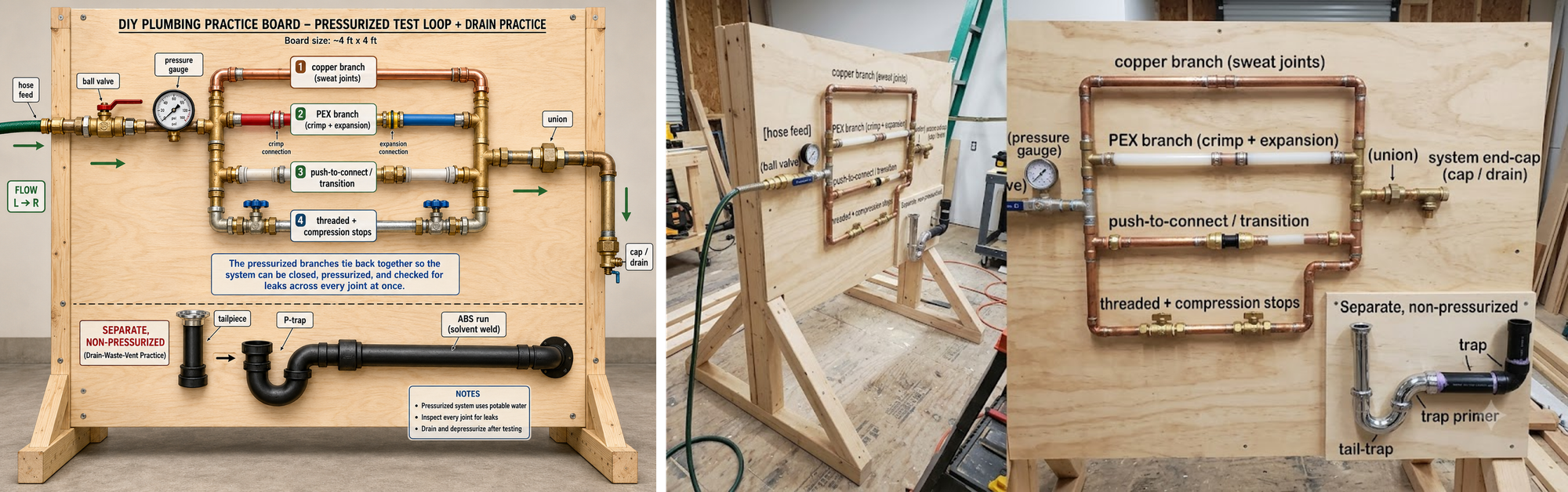
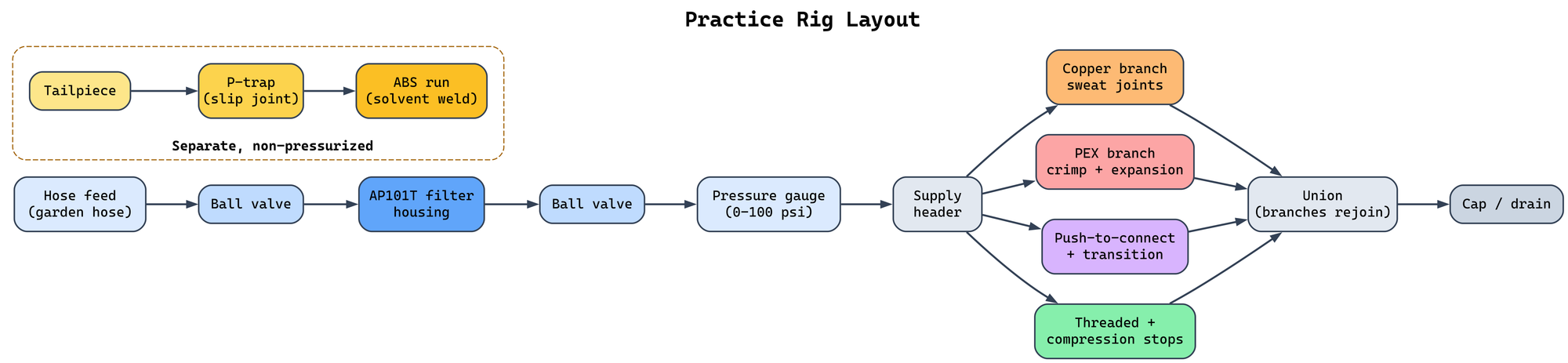
These were pretty good, but how are the copper pipes being held to the plywood? They were also not exactly the same which made me lose some trust and finally I felt like iterating on it via a code created diagram would be easier coupled with representative images. This was the end result.
To supplement this, I also had GHCP search for images that were representative of the individual components. This did not work as well as I had hoped, the images were pretty generic, cartoony/AI generated, or just the individual part. I spun up a separate session to have it go all out searching for images on the internet: "I'm not particularly happy with the state of the diagrams and images currently in this project. can you spawn subagents to look for relevant images and place them in a new folder under images/. Please take a no limits no holds barred approach to this. Search websites, even look through videos like on youtube, etc...". Previously I had set up a YouTube skill where it could search and view YouTube videos, although it's hard to do this because downloading videos to view takes a long time per video. It was able to find more good images, but a lot of them were also still poor quality. Overall, this is something that would be better served with a specialized workflow.
Building the Curriculum
With the labs and practice rig in a usable spot, I had it make the full curriculum. This was the prompt in a fresh session in plan mode so I could review and be interrogated: "We are in progress of making this workspace for learning plumbing for me. Now I want to now work on a more classroom setup. Please go think of a good educational curriculum for me that recommends any videos, books, and readings. It should be split up by roughly 30 minute lessons. Spin off subagents to explore and find things! In your plan, please propose to me the file structure.". The sub-agent instruction was key here for having it go and find a lot of sources to choose from. It spawned three sub-agents for finding the best plumbing books, video courses, and readings. Each subagent made dozens of web searches and used the YouTube search tool. The final curriculum was 10 modules with three lessons each. The beauty of this was that it linked out to videos, plumbing documentation, codes, and books rather than writing a wall of text.
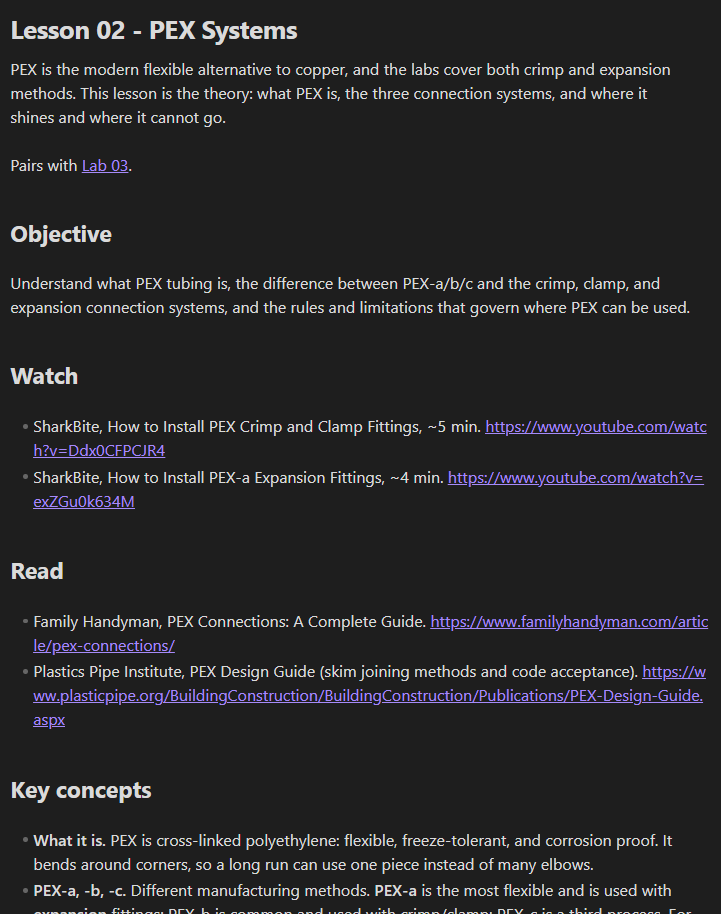
For example in this lesson in Module 3, it gives an overview of PEX tubing linking out to videos that explain and show how to install them which gives good, visual background. Then it provides reading materials that go into more depth. In my original instructions I said I wanted quizzes, but in hindsight something like this would be much better suited with an actual application-like thing rather than putting it in documents. I also had it scope the lessons to be about 30 minutes each and keep the text it wrote concise.
Conclusion
In 3-4 hours of active effort total, I was able to create a curriculum overview, a practice rig alongside labs using it, a set of 10 modules with 3 lessons each with videos, images, and readings. As someone who loves learning, having so much knowledge that is relevant and formatted in the way I like to work and learn is exciting. Throughout, it references the original preferences I gave it about the types of projects I would want to know how to do. The first three labs it made are good and I am now wanting to have it go back through the lessons and add labs to each of them (or a module level lab). Through a few iterations, I also had it collect a large amount of quality resources (ex. the videos on YouTube are largely from quality channels, same with the books and other resources). This is also a spot for some improvement though especially when it comes to images where I already had one chat that was dedicated to removing the low quality images. Also, a few of the videos were from manufacturers of products, which might be good, but I also would like more alternatives presented. I would like to be more involved in the process for books especially to make sure I am finding ones that I would enjoy. To me, education is one of the best uses for AI. It is not taking away your autonomy, it is giving you valuable skills, and doing so in a way that can be done on a budget with whatever time investment works for you. In thinking about where to take this next, I think the improvements fall under three buckets:
- Better visuals, either through generating or finding them.
- Workflows to make finding sources and validating them more reliable.
- Generating an application rather than static documents.